

If you’ve been dealing with bloating, constipation, diarrhea, gas or any other persistent digestive symptoms, you may have heard of the GI-MAP test.
The GI-MAP is a comprehensive stool test commonly used in functional and integrative medicine to investigate potential pathogens, bacterial imbalances and other markers of digestive health.
But is the GI-MAP actually worth the money? Is it accurate? Can it help identify the root cause of your digestive symptoms, or is it just another expensive test?
As a gut health practitioner, I’ve worked with many clients using GI-MAP testing. I’ve seen results reveal patterns that weren’t previously identified and provide valuable information that helped guide individualised protocols. In some cases, the findings have helped us investigate issues that conventional testing hadn’t discovered.
At the same time, I don’t believe the test is perfect. There are limitations to consider, including questions around reproducibility and how certain results should be interpreted.
My perspective is that the GI-MAP can be a very useful tool, but its value depends heavily on how the results are interpreted (and by whom) and whether they make sense in the context of the person’s symptoms and history.
Let’s look at what the test measures, what it can tell you, and when I believe it is worth considering.
What Is the GI-MAP Test?
GI-MAP stands for Gastrointestinal Microbial Assay Plus. It is a stool test developed by Diagnostic Solutions Laboratory that uses quantitative polymerase chain reaction (qPCR) technology to detect and measure the genetic material of selected microorganisms in a stool sample.
In simpler terms, it looks for DNA from specific bacteria, parasites, viruses and other microorganisms that may be present in your digestive tract.
The test also includes several markers related to digestion (enzymes), intestinal inflammation and immune activity.
Depending on the panel, the GI-MAP provides information about:
Potential pathogens: Bacteria, parasites and viruses associated with gastrointestinal infections (like C. difficile).
Opportunistic bacteria: Organisms that can be present in the gut but may become more problematic under certain circumstances.
Commensal bacteria: Bacteria that normally form part of the intestinal microbiome, usually providing health benefits.
H. pylori: A bacterium associated with gastritis and peptic ulcers, along with selected virulence factors.
(See: H. Pylori infection)Digestion markers: Including pancreatic elastase and steatocrit.
Inflammation and immune markers: Including calprotectin and secretory IgA.
Leaky gut: Zonulin is an add-on on the GI-MAP which can look at gut permeability.
(See: Leaky Gut Explained)
One of the advantages of the GI-MAP is that it brings several different types of information together in a 5-page report.
However, it is important to understand that it is a targeted PCR panel. It does not sequence the entire gut microbiome or identify every microorganism living in your digestive tract.
What Can the GI-MAP Test Detect?
Let’s look at some of the findings that make this test interesting when investigating digestive complaints.
1. Intestinal Pathogens and Parasites
The GI-MAP tests for selected microorganisms associated with gastrointestinal infections.
These include bacteria such as Salmonella and Campylobacter, parasites such as Giardia and Cryptosporidium, and certain viruses.
Identifying a potential pathogen can be helpful when investigating persistent digestive symptoms, particularly when there is a history of gastrointestinal infection, travel or possible parasitic exposure.
It is important to remember that detecting microbial DNA does not always mean that a living organism is still present or actively causing an infection. Positive findings need to be interpreted alongside symptoms and, when appropriate, confirmed using conventional diagnostic testing.
2. Opportunistic Bacteria
This is one of the areas I find particularly interesting when reviewing GI-MAP results. Often times, this section will have a few high positives for my client experiencing symptoms. A lot of these bacteria are also known SIBO bacteria.
The test measures selected bacteria that can naturally be found in the intestinal tract but can become problematic when the microbial environment changes.
Examples include:
Citrobacter species
Klebsiella species
Enterobacter species
Morganella species
Pseudomonas species
Certain Streptococcus and Staphylococcus species
These organisms are often discussed in relation to dysbiosis, which refers broadly to changes and imbalances in the composition or function of the gut microbiome. As you can see with all my articles on the topic, I really specialize in this area and love to geek on these specific microbes.
In my clinical experience, looking at these organisms alongside the person’s symptoms and other findings can help identify patterns and explain the current situation.
An elevated bacterial marker may be one piece of a larger picture involving bloating, altered bowel habits or other digestive complaints.
However, an elevated result does not automatically mean that the organism is causing symptoms or needs to be eliminated. A high Citrobacter result, for instance, does not independently establish an infection, hydrogen SIBO or histamine intolerance. It all depends on the rest of the test report.
The important part is understanding what the finding means in the context of the individual.
3. Helicobacter pylori
The GI-MAP includes testing for Helicobacter pylori, a bacterium that can colonize the stomach and contribute to gastritis and peptic ulcers.
It also reports selected H. pylori virulence factors, which are bacterial characteristics associated with pathogenic potential.
This can provide additional information when investigating upper digestive symptoms, although positive findings may need confirmation using an appropriate validated clinical test.
4. Digestion and Inflammation Markers
Beyond microorganisms, the GI-MAP includes markers that can provide insight into digestive function and intestinal health.
Some examples include:
Pancreatic elastase: Helps assess pancreatic enzyme output. Low levels may suggest pancreatic exocrine insufficiency and warrant further investigation.
Steatocrit: Estimates the amount of fat in the stool and may help identify fat malabsorption.
Calprotectin: A marker of intestinal inflammation. Elevated levels can occur with inflammatory bowel disease and other gastrointestinal conditions.
Secretory IgA: An antibody involved in the intestinal immune response.
Occult blood: Screens for hidden blood in the stool (unseen to the human eye).
These markers can help identify areas that deserve further investigation. They are not all diagnostic on their own, and abnormal results may require conventional follow-up testing.
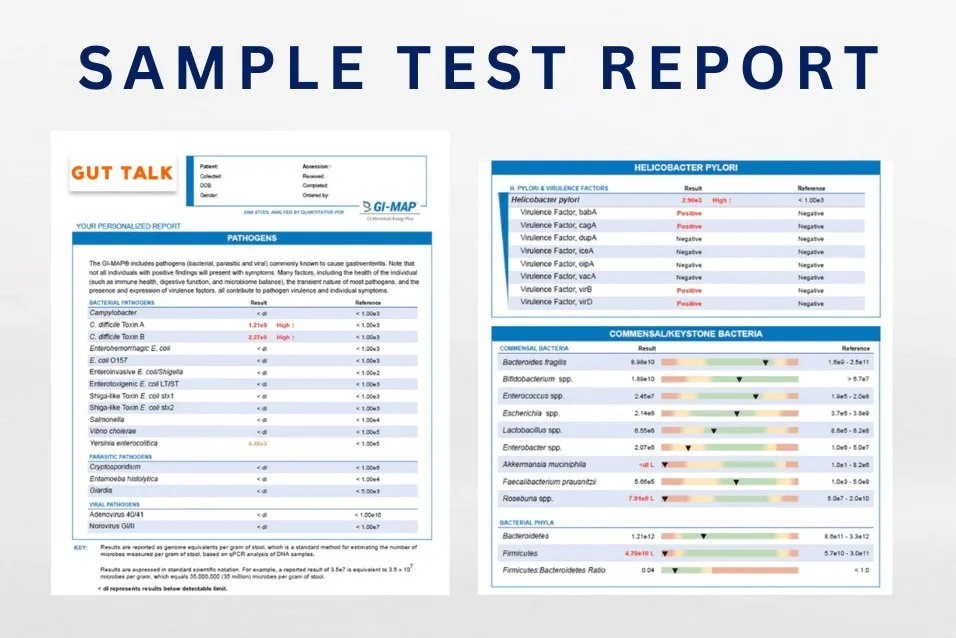
Sample of the first two pages of the GI-MAP report.
Is the GI-MAP Test Accurate?
This is probably one of the most important questions to ask before investing in the test.
The GI-MAP uses qPCR, an established molecular technology that detects specific DNA sequences. PCR is widely used in clinical diagnostics, including testing for infectious diseases (it was the technology used for COVID-19 testing).
However, the fact that a test uses PCR does not automatically mean every result is accurate or clinically meaningful.
There are two important concepts to understand:
Analytical validity: Does the test reliably detect what it claims to measure?
Clinical validity: Does the result accurately tell us whether someone has a particular condition or whether a microorganism is causing their symptoms?
A test can detect microbial DNA without proving that the organism is responsible for a person’s digestive complaints.
What Does the Research Say About GI-MAP Accuracy?
A 2020 independent study published in Access Microbiology evaluated the GI-MAP’s ability to detect selected bacterial and parasitic pathogens in experimentally prepared stool samples.
The researchers reported substantial variability, with an estimated sensitivity of 80% and specificity of 26% in their experimental setup. The low specificity raised concerns about false-positive pathogen results.
It is important to understand that this was a relatively small laboratory evaluation using prepared samples. It does not establish the accuracy of every GI-MAP marker or every result in real-world clinical practice.
Nevertheless, it is an interesting study that should not be ignored.
My Clinical Experience With GI-MAP Reliability
I think it is important to distinguish between the technology behind a test and how consistently it performs in practice.
Over the years, I’ve seen many GI-MAP results that have revealed interesting patterns and helped guide my clients’ protocols, ultimately leading them towards symptom resolution. In other cases, findings have provided a direction for further investigation when symptoms had persisted despite previous approaches.
However, I have also come across situations that raise questions about reproducibility.
For example, I’ve heard of instances where samples from the same stool submitted under different names did not produce fully matching results. While this does not establish that the test is unreliable, it does raise questions about how consistently certain findings are reproduced.
There can be several reasons why stool test results differ, including differences in sample collection, timing and handling, and analytical variability.
This is why I am cautious about treating every individual marker as an absolute finding.
My position is that the GI-MAP provides very valuable information, but no stool test should be interpreted in isolation or treated as the complete picture of someone’s gut health.
Can the GI-MAP Diagnose SIBO?
No. The GI-MAP cannot diagnose small intestinal bacterial overgrowth (SIBO).
The test analyses a stool sample, which primarily reflects microorganisms and material passing through the large intestine. SIBO, on the other hand, involves excessive bacterial growth in the small intestine.
These are different areas of the digestive tract.
A person may have elevated opportunistic bacteria on a GI-MAP and also have SIBO, but the stool test cannot establish that the bacteria are present in the small intestine.
If SIBO is suspected, a SIBO breath test is generally used to investigate it. These tests measure gases produced by intestinal microorganisms after the person consumes a test substrate.
The GI-MAP and a SIBO breath test therefore answer different questions and complement each other.
Can the GI-MAP Identify the Root Cause of IBS?
It can definitely provide useful clues.
IBS is a complex condition involving several possible mechanisms, including altered gut motility, visceral hypersensitivity, changes in gut-brain signalling and, in some people, changes in the intestinal microbiome.
The GI-MAP can identify findings worth looking into, such as selected pathogens, elevated opportunistic bacteria or abnormal digestive markers.
In my experience, these findings can help guide a more targeted approach rather than relying exclusively on symptom management.
However, the test cannot independently diagnose IBS (which is done exclusively by symptoms and the Rome IV criteria), or identify every underlying contributor. Motility, pelvic floor dysfunction, food intolerances, medication effects and other gastrointestinal conditions may also need to be considered.
The goal is to use testing to help build a clearer picture, not to assume that every digestive complaint comes down to bacterial imbalance.
Is the GI-MAP Worth the Money?
So, after considering the benefits and limitations, is the GI-MAP worth the cost?
My answer is that it can be, particularly when there is a clear reason to investigate someone’s digestive health beyond what has already been assessed. Many clients with chronic issues are happy to finally get some answers.
For my clients, having more information has helped us move away from repeatedly guessing and towards a more targeted approach.
However, I don’t believe everyone with digestive symptoms needs a GI-MAP.
The value of the test depends on three things.
1. Whether There Is a Clear Reason to Test
Testing should start with a clinical question.
What are we trying to investigate? Are there persistent symptoms, a history of gastrointestinal infection, suspected malabsorption or other findings that justify further assessment?
Ordering a comprehensive stool test simply because someone has bloating is not necessarily the best starting point.
2. Whether the Results Will Help Guide the Approach
A test is only useful if the information it provides can meaningfully influence what happens next.
If the findings help identify areas worth investigating or guide an individualised protocol, the test may be worthwhile.
However, more findings do not necessarily mean more answers. Treating every marker outside the laboratory reference range can lead to unnecessary interventions.
3. Whether Someone Can Interpret the Results Properly
This is particularly important with commercial stool testing.
The report contains a lot of information, but understanding what matters clinically is not always straightforward.
An elevated opportunistic bacterium does not automatically require antimicrobial treatment. A low commensal bacterium does not automatically mean someone needs a probiotic. An abnormal marker may require confirmation using a different test.
The results need to be considered alongside symptoms, health history, medications, diet and other investigations.
This is where working with a qualified practitioner who understands digestive health and the limitations of the test becomes important.
When Would I Consider the GI-MAP?
In my practice, I consider the GI-MAP when there is a specific reason to investigate aspects of digestive health that may not have been addressed by previous testing.
For example:
Persistent digestive symptoms without a clear explanation.
A history of gastrointestinal infection or suspected parasitic exposure.
Suspected dysbiosis alongside other relevant clinical findings.
Digestive symptoms that may involve pancreatic insufficiency or fat malabsorption.
A need to investigate selected microbial and digestive markers together.
However, it is not always the first test I recommend.
For someone with suspected SIBO, a breath test is more appropriate. For someone with persistent diarrhea, conventional stool pathogen testing or inflammatory markers in blood can be quicker and cheaper. For someone with suspected pancreatic insufficiency, pancreatic elastase can be assessed directly.
If more than one test would be necessary, then it often makes sense to get the GI-MAP which englobes multiple makers we are looking to test for.
Frequently Asked Questions About the GI-MAP
How much does the GI-MAP test cost?
The price varies depending on the practitioner, your location, and whether the cost includes a consultation and interpretation. It is generally a private-pay test, so it may not be covered by insurance.
Before ordering, ask whether the quoted price includes the test kit, laboratory analysis and a review of the results.
For my services, all my GI-MAP Packages include my interpretation and a 90-min live consultation.
Can the GI-MAP detect parasites?
Yes. The GI-MAP tests for selected parasites, including organisms such as Giardia and Cryptosporidium. However, it does not detect every possible parasite.
Can the GI-MAP detect Candida?
The GI-MAP includes testing for selected fungal organisms, including Candida species. However, in my clinical experience, the GI-MAP is not a great tool to detect this fungi. It doesn’t always show up on testing, even when it is present and confirmed via another testing method. This is one of the known weaknesses of the GI-MAP.
Can the GI-MAP detect SIBO?
No. The GI-MAP analyses stool and cannot determine whether bacteria are overgrown in the small intestine. Some practitioners might make hypothesis and extrapolations based of this, but it is not an approved diagnostic tool for SIBO. A SIBO breath test is used to investigate hydrogen, methane and hydrogen sulfide production associated with small intestinal bacterial overgrowth.
Does a high result mean I need antimicrobial treatment?
Not necessarily. A result above the laboratory reference range does not automatically mean an organism is causing symptoms or needs to be eliminated.
Treatment decisions should be based on the organism, the person’s symptoms, relevant medical history and the clinical significance of the finding. Please discuss with your practitioner.
Can I order a GI-MAP without a practitioner?
Availability and ordering requirements depend on the laboratory and country. You can order it yourself in the USA, I also offer on my Fullscript. However, I strongly recommend working with a qualified practitioner who understands the test report and can interpret your results in context.
Having a report with dozens of markers is not particularly helpful if you do not know which findings matter and which do not.
Is the GI-MAP Worth It? Making an Informed Decision
I believe the GI-MAP can be a valuable tool when investigating persistent digestive symptoms. In my clinical experience, it has helped reveal patterns, guide protocols and provide answers that were not always apparent from symptoms alone.
But I also recognise its limitations. Questions around reproducibility, analytical accuracy and the clinical significance of certain findings mean that results should never be taken at face value.
The test is not a substitute for conventional medical investigation, and it cannot diagnose every digestive condition. It is one piece of information that needs to be considered alongside the person’s symptoms, history and other relevant findings.
Ultimately, the value of the GI-MAP is not in how many markers it measures, but in whether the information helps guide the right next steps.
At Gut Talk, I take an individualised approach to digestive health. Depending on your symptoms and history, this may involve GI-MAP testing, SIBO breath testing or other investigations to help build a clearer picture of what may be contributing to your digestive concerns.
Learn more about working with me at Gut Talk.
Ready to book your GI-MAP Package?
I offer GI-MAP testing with a personalised interpretation session. As a practitioner trained in the GI-MAP directly by Diagnostic Solutions Laboratory, I will walk you through your results, explain what the findings may mean in the context of your symptoms, and help you understand which areas may deserve further attention.
You’ll receive more than just a laboratory report. We’ll discuss your results together and identify an individualised approach based on your digestive health history and goals.