

Why Take Butyrate
Butyrate is one of the most important compounds for gut health, yet it’s rarely discussed in a clear or practical way.
Many people hear about butyrate in the context of fiber, probiotics, or inflammation, but aren’t sure what it actually does — or how to increase it in a meaningful way.
Looking into butyrate helps explain why gut health isn’t just about killing microbes or adding supplements. What matters most is supporting the environment that allows the gut lining, immune system, and microbiome to function properly.
What Is Butyrate?
Butyrate is a short-chain fatty acid (SCFA) produced when certain gut bacteria ferment dietary fiber. Unlike fats from food, butyrate is made inside the colon and is used locally by the gut lining.
Butyrate is not simply a nutrient floating through the bloodstream; it is a primary fuel source for colon cells, also known as colonocytes. When butyrate production is adequate, the gut lining has the energy it needs to maintain barrier integrity and regulate inflammation.
Why Butyrate Is So Important for Gut Health
Healthy colon cells rely on butyrate for energy. When butyrate availability is low, colon cells are forced to switch to less efficient energy pathways, which can weaken the gut barrier and promote inflammation.
Adequate butyrate helps:
Maintain tight junctions in the intestinal lining (preventing leaky gut)
Reduce low-grade inflammation in the colon
Support immune tolerance in the gut (less food sensitivities)
Keep oxygen levels low in the colon, which favors beneficial anaerobic bacteria
A low-oxygen environment is particularly important. When butyrate production drops, oxygen can leak into the gut lumen, shifting the microbiome toward more inflammatory species.
Which Bacteria Produce Butyrate?
Butyrate is produced by a relatively specific group of gut bacteria, mostly belonging to the Firmicutes phylum. Some of the best-studied butyrate producers include Faecalibacterium prausnitzii, Roseburia, Eubacterium rectale, and Anaerobutyricum hallii.
These bacteria don’t thrive in isolation; they depend on dietary fiber, resistant starches, and metabolic cross-feeding from other microbes. This is why simply “adding a probiotic” rarely restores butyrate production if the broader ecosystem is not supported. For more information about probiotics, read my article on probiotics strains decoded.
Low Butyrate and Digestive Symptoms
Low butyrate levels are commonly observed in people with IBS, chronic constipation, inflammatory bowel disease, and after repeated antibiotic or antimicrobial use. It’s also frequently seen in dysbiosis patterns where beneficial anaerobes are depleted.
Symptoms associated with poor butyrate production can include:
Abdominal pain or discomfort
Irregular bowel movements
Increased gut permeability (leaky gut)
Heightened gut sensitivity
Importantly, low butyrate is often a downstream effect of other issues such as poor motility, restricted diets, or long-term gut stress.
What About Butyrate Supplements?
This is where things often get confusing.
Oral butyrate supplements are absorbed primarily in the small intestine, from where they enter the bloodstream. In the small intestine, butyrate may have some anti-inflammatory or signaling effects, but small intestinal cells do not use butyrate as their primary fuel in the same way colon cells do.
Once absorbed systemically, butyrate may have beneficial effects in other tissues including the brain, which is why oral supplementation can be helpful in certain inflammatory or metabolic contexts.
However, most oral butyrate supplements do not reliably deliver butyrate to the colon, where it is most needed for gut barrier support. For the butyrate content can get delivered lower in the intestines, a supplement needs to be enteric-coated.
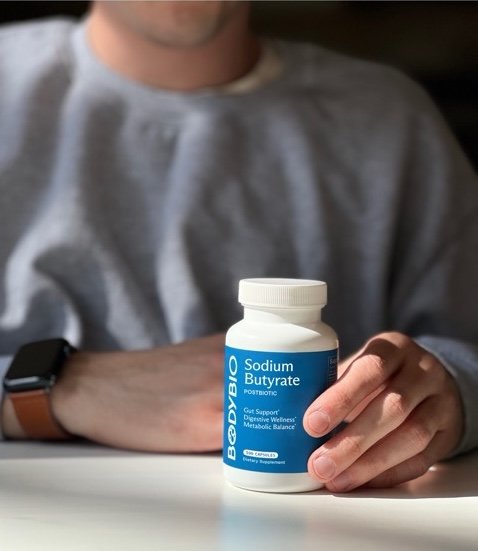
One brand that does coat their butyrate to allow for its intact delivery to the colon is BodyBio. Their butyrate was tested in this study here, and found to be one of the most bioavailable on the market. (You can use code GUTTALK for 20% off their products.)
Researchers are also actively working on delayed-release and colon-targeted butyrate formulations. Rectal butyrate preparations, such as enemas or suppositories, can deliver butyrate locally to the rectum or sigmoid colon. While this may be useful in specific clinical situations, it does not affect the majority of the large intestine.
When the goal is improving colonic gut health, select supplements may be helpful, but I wouldn’t consider them a proper substitute for microbial butyrate production.
The Best Way to Increase Butyrate
The most reliable way to support butyrate is to help your microbiome produce it.
This starts with feeding butyrate-producing bacteria through diet.
Fibers such as resistant starch, soluble fiber (pectin), and certain prebiotic fibers (FOS) are fermented into short-chain fatty acids, including butyrate.
Resistant starch (RS)
Resistant starch is one of the strongest drivers of butyrate production.
It resists digestion in the small intestine and becomes fuel for key butyrate producers such as Faecalibacterium prausnitzii and Roseburia species.
Common sources include:
Cooked and cooled potatoes, rice, and pasta
Green (unripe) bananas or green banana flour
Cooked and cooled oats
Legumes such as lentils and chickpeas
Resistant starch is particularly important because it supports cross-feeding, where one group of bacteria breaks it down into smaller substrates that butyrate-producing bacteria then use.
Inulin and fructooligosaccharides (FOS)
Inulin and FOS are well-known prebiotic fibres found in foods like chicory root, onions, garlic, leeks, asparagus, and Jerusalem artichokes. Note that they are fodmaps.
They primarily stimulate Bifidobacteria, which do not make butyrate themselves. However, they indirectly increase butyrate through cross-feeding interactions with butyrate producers.
This is why inulin can raise butyrate levels in some people, but also why it can cause more bloating in others, especially in IBS or SIBO sufferer.
Pectins
Pectins are soluble fibres mainly found in apples and citrus fruits (with the pith).
They are fermented into a mix of short-chain fatty acids, including butyrate, and may be especially useful in people recovering from gut inflammation or post-infectious IBS.
What matters more than the fibre itself
Butyrate production depends on three things working together:
The presence of the right fibre
The presence of butyrate-producing bacteria
A gut environment that allows fermentation without excessive inflammation or dysbiosis
This is why simply “adding fibre” does not always increase butyrate, and why some people feel worse when they do.
Supporting butyrate is less about forcing it into the system and more about restoring the conditions that allow the gut to make it naturally.
Butyrate is not just another gut health buzzword. It has a direct link between diet, the microbiome, and the integrity of the gut lining.
While supplements can support the process, long-term gut health depends on nurturing the bacteria that produce butyrate where it matters most: in the colon. This requires a broader approach based on the entire ecosystem rather than a single pill.